British Royal Navy Shipwrecks in the Florida Keys: HMS Loo
EducationBritish Royal Navy Shipwrecks in the Florida Keys: HMS Loo

Why is it that a reef located just off Big Pine Key in the Florida Keys, that is popular with divers, is named after the picturesque coastal town, Looe in Cornwall, England? Answer, Looe Reef is the site where HMS Loo, a 44-gun fifth rate frigate was shipwrecked after running onto the reef in 1744. As a result the ships crew found themselves stranded on a remote shoal in emery territory, facing the possibility of capture by the Spanish or worst still Calusa Indians, who treated the English with contempt and would most likely have murdered them.
In 1743 Spain was at war with England. Florida belonged to Spain and the British colonies in the Carolina’s and Georgia were concerned about attacks from Spanish forces. Spain had already invaded Georgia the previous year, but an army under the command of general Oglethorpe had forced the Spanish to retreat. Ships from His Majesty’s Royal Navy were sent to patrol the coasts of Florida and especially the Florida Straits, with orders to intercept enemy vessels . One of those ships was HMS Loo.
The Loo was built at the Limehouse dockyard, London in 1706. She was 124 feet long and weighed 685 tons. Her captain was Ashby Utting. Initially she was used as a convoy ship and to intercept pirate ships.
On February 4 1744, HMS Loo was cruising near Cuba when it spotted the sail of an unknown vessel. The vessel was flying the French flag and at that time France and England were at peace. HMS Loo gave chase and boarded the vessel. Some of the vessels crew tried to destroy some documents or throw them over board, however the documents were retrieved. It was determined that the ship was the Billander Betty, a British merchant ship that had been previously captured by the Spanish. Indeed, the ships crew were Spanish and the documents found were sensitive, written in Spanish and French. Captain Utting decided to escort the ship to Charles Town, (Charleston) South Carolina for investigation.
As the ships were heading north along the gulf stream of the Florida Straits, Captain Utting misjudged their proximity to the Florida Reef. An attempt was made to avoid the reef but the rudder and tiller of HMS Loo hit the reef, was destroyed and the ship was grounded. Heavy seas pushed the Loo further west onto the reef and the impact crushed the ships hull. The Billander Betty, which was being towed by the Loo, capsized . It started taking on water and eventually sank during the night. By daybreak the crews of both ships, which numbered 274, had salvaged as many supplies as they could. They found themselves on an island that was little more than a shoal and could be washed over by heavy seas at anytime.
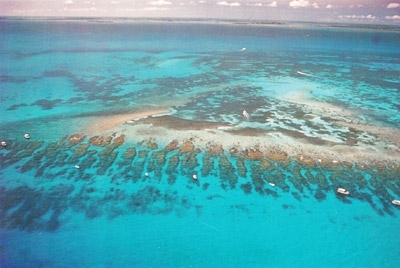
Looe Key, the Florida Keys.
Fortunately a small Spanish sloop was spotted just off the coast. Captain Utting sent three launches with armed marines. After giving chase the sloop was intercepted and the following morning the sloop returned with the launches in tow. Because there were too many crew members for the sloop alone, 90 members of the crews were put in the launches from HMS Loo and sent to the Bahamas. Captian Utting ordered HMS Loo to be destroyed using gun powder, in order that the ship and its guns did not full into enermy hands. The remainder of the crews, some 184 men loaded supplies on the sloop and headed north, arriving in South Carolina on February 13.
When Captain Utting returned to England he was court martialed for the loss of his ship. However he was acquitted by the British Admiralty after it was determined that unusual, possibly unknown currents had caused the sinking of HMS Loo. Today the wreck of HMS Loo forms part of Looe Key Marine Sanctuary, which is located 8 miles southwest of Big Pine Key.
Images from flickr.com with creative commons licence.